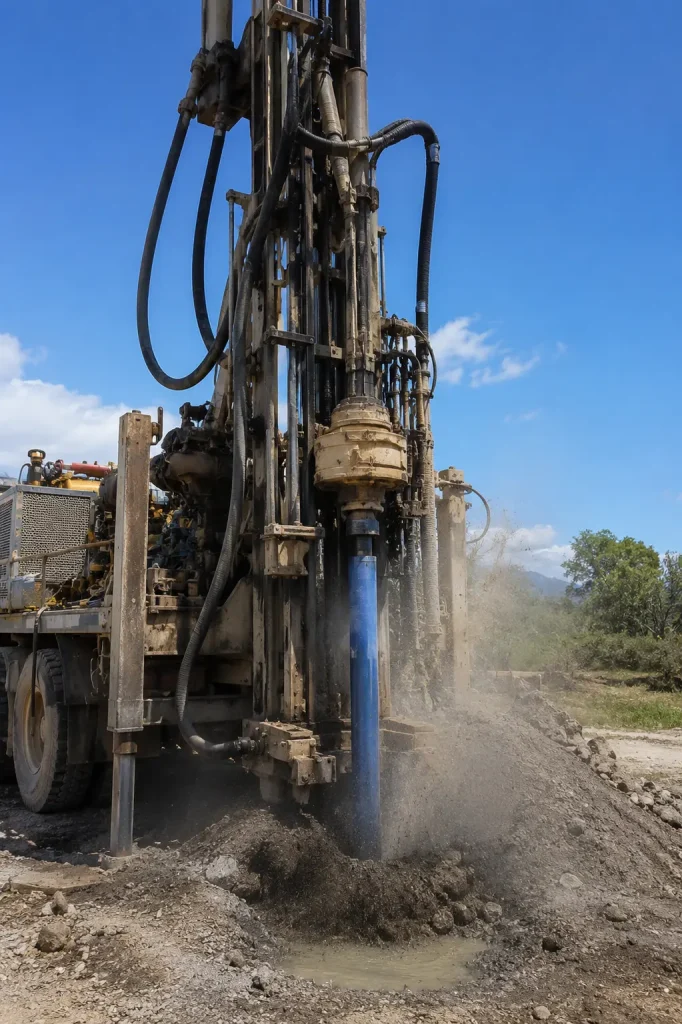
Direct Rotary Drilling for Water Wells
Learn how direct rotary drilling uses a rotating drill bit and continuously circulating drilling fluid to construct water wells efficiently in a wide range of formations.
Direct rotary drilling is one of the most widely used methods for water-well construction. A drill bit rotates at the bottom of the borehole while drilling fluid circulates through the drill pipe, removes cuttings, and helps maintain the borehole during drilling.
The method can achieve relatively high penetration rates and can be adapted to different formation conditions through the selection of drill bits, drilling fluids, drill-string components, and operating techniques.
Before choosing where to drill, a groundwater site assessment can also help compare potential drilling locations and provide additional information for the drilling contractor.
What Is Direct Rotary Drilling?
Direct rotary drilling is a water-well drilling method that uses a rotating drill bit together with continuous circulation of drilling fluid. The drill bit is attached to the lower end of a string of drill pipe. The drilling rig rotates the drill string and bit, allowing the bit to cut, shear, crush, or chip the formation at the bottom of the borehole. At the same time, drilling fluid is pumped downward through the drill pipe.
The fluid exits through openings or jets in the drill bit and then travels upward through the space between the drill pipe and the borehole wall. As the fluid returns to the surface, it carries drill cuttings with it. At the surface, the cuttings are separated from the fluid before the cleaned drilling fluid is recirculated into the borehole. This continuous drilling-and-circulation process allows rotary drilling to operate efficiently in many geological formations.
Important: Direct rotary drilling is a method of constructing a borehole. It does not independently determine the best groundwater location or guarantee a particular well yield.
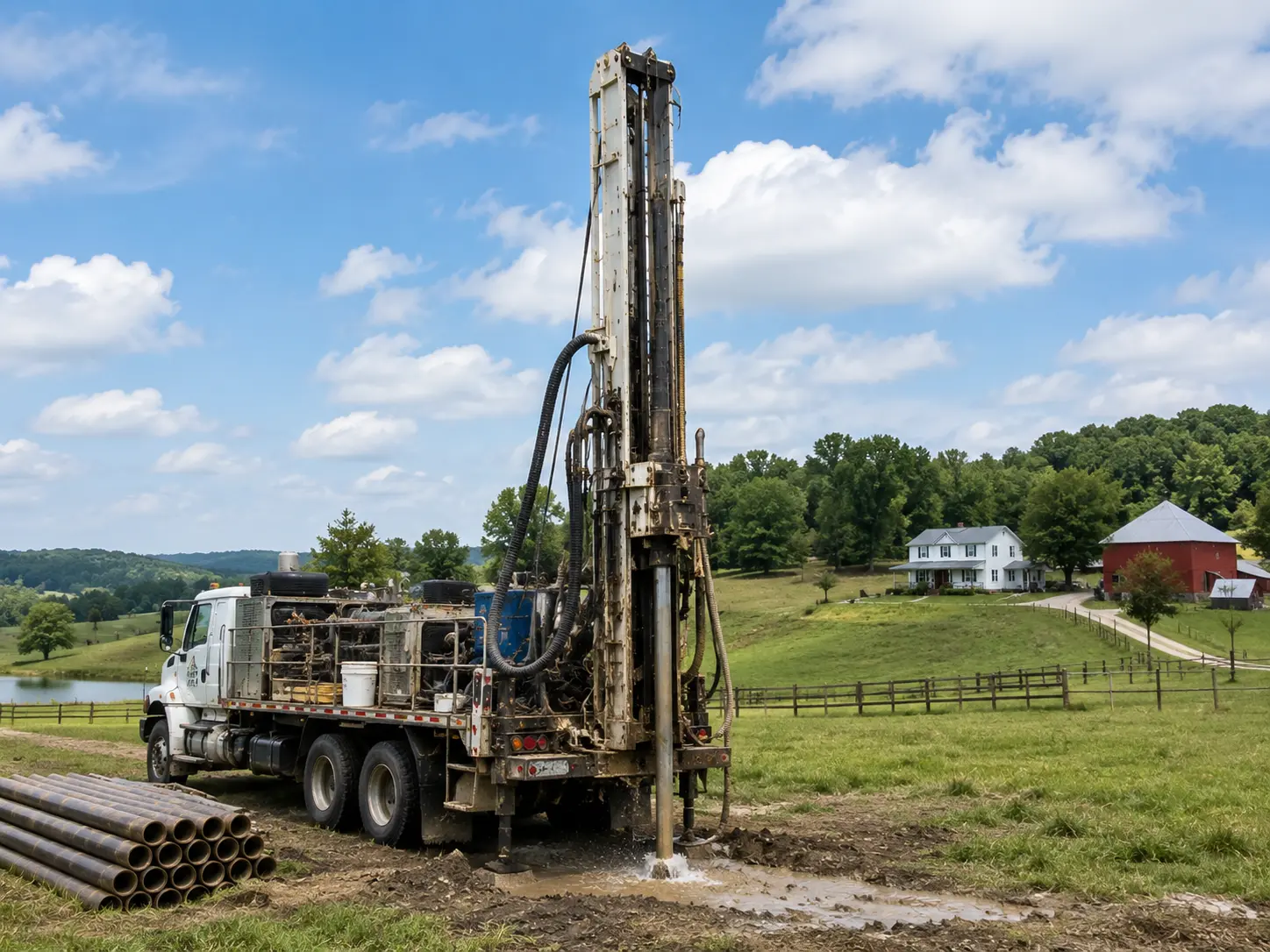
How Direct Rotary Drilling Works
- The drilling rig is positioned over the proposed well location.
- The drill bit and drill string are lowered into position.
- The rig rotates the drill string.
- The rotating bit cuts or crushes the formation.
- A pump sends drilling fluid down through the drill pipe.
- Fluid exits through openings in the drill bit.
- Returning fluid carries cuttings upward through the borehole.
- Cuttings are separated from the drilling fluid at the surface.
- The cleaned drilling fluid is recirculated.
- Additional sections of drill pipe are added as the borehole becomes deeper.
- Casing and well screen are installed according to the well design.
- The completed well is developed and tested.
The exact drilling procedure depends on the geology, expected depth, borehole diameter, equipment, drilling-fluid program, and well design.
How Drilling Fluid Circulates
Drilling-fluid circulation is one of the defining features of direct rotary drilling. The drilling fluid is pumped from the surface down through the center of the drill pipe. It exits through ports or jets near the drill bit.
The fluid then moves upward through the annular space between the drill pipe and the borehole wall. As the fluid travels upward, it carries drill cuttings to the surface.
At the surface, the drilling fluid may enter settling pits, portable tanks, mud-cleaning equipment, or other circulation-control systems.
The heavier cuttings settle or are separated from the fluid. The cleaned fluid can then be pumped back down the drill pipe and reused. This creates a continuous circulation system during drilling.
Why Drilling Fluid Is Important
- Carrying drill cuttings to the surface
- Helping stabilize the borehole wall
- Cooling the drill bit
- Cleaning the cutting surfaces of the bit
- Suspending cuttings when circulation temporarily stops
- Reducing certain drilling problems
- Supporting efficient borehole construction
The composition and properties of the drilling fluid should be selected and managed according to the geological conditions encountered.
Improper drilling-fluid management can contribute to:
- Excessive borehole erosion
- Cuttings accumulation
- Lost circulation
- Formation plugging
- Difficult well development
Main Types of Drill Bits Used in Direct Rotary Drilling
Two common categories used in direct rotary drilling are:
- Drag bits
- Roller cone bits
Drag Bits– Drag bits use cutting blades to shear through the formation. They can work efficiently in softer geological materials such as sand, clay, silt, and some soft rock formations. Drilling-fluid jets direct fluid toward the cutting surfaces to cool the bit, clean the blades, and remove loosened material. Drag bits generally perform best in relatively soft formations and may be less suitable in coarse gravel, boulder formations, or very hard rock.
Roller Cone Bits– Roller cone bits use rolling cutters that crush and chip the formation. The cutters may contain hardened steel teeth, tungsten carbide inserts, or other wear-resistant cutting elements. Different tooth shapes and spacing can be selected according to formation hardness. Roller cone bits can be used in harder formations where a drag bit would be less effective.
Reamers and Under-Reamers
Sometimes a borehole must be straightened, cleaned, or enlarged. A reamer may be used for these purposes. An under-reamer is used when the borehole needs to be enlarged below existing casing. This can be useful when additional space is required around a well screen or filter pack without drilling the entire borehole at the larger diameter. The appropriate reaming method depends on the well design and geological conditions.
Main Components of the Direct Rotary Drill String
- Drill bit
- Drill collars
- Stabilizers
- Drill pipe
- Kelly on certain rotary-table rigs
Modern top-head rotary rigs may use a different drive arrangement and may not require a kelly.
Drill Collars
Drill collars are heavy sections of the drill string positioned near the drill bit. Their weight helps apply controlled force to the bit, improve penetration, maintain borehole direction, and reduce unwanted bending of the drill string.
Stabilizers
Stabilizers help keep the drill string centered inside the borehole. They can help maintain hole direction, reduce unwanted deviation, and improve drilling stability. The stabilizer design should also allow enough space for drilling fluid and cuttings to move upward through the borehole.
Drill Pipe
Drill pipe connects the drilling rig to the bottom-hole drilling assembly. It transfers rotation to the drill bit, carries drilling fluid downward, supports the bottom-hole assembly, and allows the borehole to be extended by adding additional pipe sections.
Kelly and Rotary Table Systems
Some direct rotary drilling rigs use a rotary table and kelly system. The kelly is the upper section of the drill string that passes through the rotary table. As the rotary table turns, the kelly transfers rotation to the drill string while moving vertically as the bit advances.
Top-Head Drive Systems
Many modern rotary drilling rigs use a top-head drive. The rotating drive unit moves vertically along the rig mast and connects directly to the drill pipe. This arrangement can improve drill-pipe handling, drilling efficiency, rig automation, and speed when adding or removing drill rods.
Adding and Removing Drill Pipe
As the borehole becomes deeper, additional drill pipe must be added to the drill string. When the drill string is removed from the borehole, the process is often called tripping out. Returning the drill string to the borehole is called tripping in.
Modern rigs may use pipe racks, rod carousels, automatic clamps, and hydraulic handling systems to make this process faster and safer. Before circulation is stopped to add or remove drill pipe, the crew may circulate fluid long enough to remove excess cuttings from the bottom of the borehole and reduce the risk of sticking.
Where Is Direct Rotary Drilling Commonly Used?
Depending on the drilling equipment and bit selected, it may be considered in:
- Sand
- Clay
- Silt
- Soft rock
- Sedimentary formations
- Moderately hard rock
- Selected hard-rock conditions
Direct rotary drilling may be especially useful where:
- Relatively fast drilling is desired
- A deeper borehole is required
- Continuous cuttings removal is beneficial
- Borehole stability can be maintained with drilling fluid
- The site provides suitable access for the rig
- The drilling contractor has appropriate equipment and experience
Advantages of Direct Rotary Drilling
Relatively High Penetration Rates
Direct rotary drilling can achieve relatively high drilling rates in many formation types.
Continuous Removal of Cuttings
Drilling fluid continuously carries loosened material toward the surface, reducing the need to repeatedly stop drilling to remove cuttings.
Minimal Temporary Casing During Some Drilling Operations
Where drilling fluid can adequately support the borehole, less temporary casing may be required during drilling.
Efficient Mobilization
Modern truck-mounted rotary rigs can often be mobilized and demobilized efficiently when site access is suitable.
Well Screens Can Be Installed as Part of Completion
Direct rotary drilling can accommodate well-screen and casing installation as part of the well-completion process.
Adaptable to Different Formations
Different bits, drilling-fluid programs, stabilizers, drill collars, and operating settings allow rotary equipment to be adapted to changing subsurface conditions.
Limitations of Direct Rotary Drilling
Drilling Equipment Can Be Expensive
Rotary drilling rigs are complex machines and can represent a substantial equipment investment. Their operation and maintenance require trained personnel.
Significant Maintenance Requirements
Pumps, hydraulic systems, drive systems, drill pipe, bits, and fluid-control equipment require regular inspection and maintenance.
Site Access Can Be Limited
Large rotary rigs may have difficulty on steep slopes, wet ground, soft soil, narrow access, limited turning space, or sites with overhead obstructions.
Drilling Fluid Requires Careful Management
Poor fluid management can contribute to lost circulation, formation plugging, borehole erosion, difficult well development, and cuttings accumulation.
Formation Samples May Be Less Precise
Because cuttings are transported upward by circulating fluid, recovered material may not represent an exact depth without specialized sampling procedures.
Extreme Cold Can Affect Operations
Very cold weather can make drilling-fluid management and equipment operation more difficult.
Direct Rotary vs. Air Rotary vs. Cable Tool Drilling
| Factor | Direct Rotary | Air Rotary | Cable Tool |
| Main drilling action | Rotating drill bit | Rotating bit or DTH hammer | Repeated percussion |
| Cuttings removal | Drilling fluid | Compressed air | Bailer or sand pump |
| Drilling speed | Generally high | Often high in competent rock | Generally slower |
| Loose formations | Often suitable | Can require casing | Can work with advancing casing |
| Hard rock | Depends on bit and system | Often very effective | Possible but usually slower |
| Borehole support | Drilling fluid can help stabilize | Often requires stable formation or casing | Casing can follow drilling |
| Fluid use | Moderate to high | Usually lower | Usually lower |
| Formation sampling | Requires care | Good observation of cuttings | Very good observation |
| Equipment size | Often larger | Often larger | Some rigs are smaller |
| Common strength | Efficient drilling in many formations | Fast hard-rock penetration | Difficult or mixed formations |
Direct Rotary Drilling vs. Air Rotary Drilling
Both methods use a rotating drill bit. The major difference is how the cuttings are removed. Direct rotary drilling typically uses circulating drilling fluid, while air rotary drilling uses compressed air. Direct rotary drilling may be better suited to certain loose or unstable formations because drilling fluid can help support the borehole. Air rotary drilling is often highly effective in competent hard rock. Learn more about air rotary drilling for water wells.
Direct Rotary Drilling vs. Cable Tool Drilling
Direct rotary drilling uses continuous rotation and fluid circulation. Cable tool drilling repeatedly raises and drops a drill string and periodically removes cuttings with a bailer. Direct rotary drilling is generally faster. Cable tool drilling may have advantages in certain boulder-rich formations, mixed formations, lost-circulation conditions, unstable ground, or difficult drilling environments. Learn more about cable tool drilling for water wells.
Why Evaluate Groundwater Before Drilling
Direct rotary drilling determines how the borehole is constructed. It does not determine where the most promising groundwater target is located. Groundwater conditions can vary significantly across a property.
Nearby wells may have different well depths, geological formations, water-bearing zones, aquifer thickness, water yields, and water quality. Before selecting a drilling location, property owners may benefit from gathering as much site-specific information as possible.
A pre-drilling evaluation may include:
- Reviewing nearby water-well records
- Studying available geological information
- Evaluating property access
- Comparing potential well locations
- Completing a groundwater survey
- Estimating potential water-bearing zones
- Sharing survey information with the drilling contractor
WaterFind USA uses advanced seismic methods and available well information to support pre-drilling groundwater evaluation.
Survey findings are estimates. Actual groundwater conditions can only be confirmed through drilling, well development, pump testing, and water-quality testing.
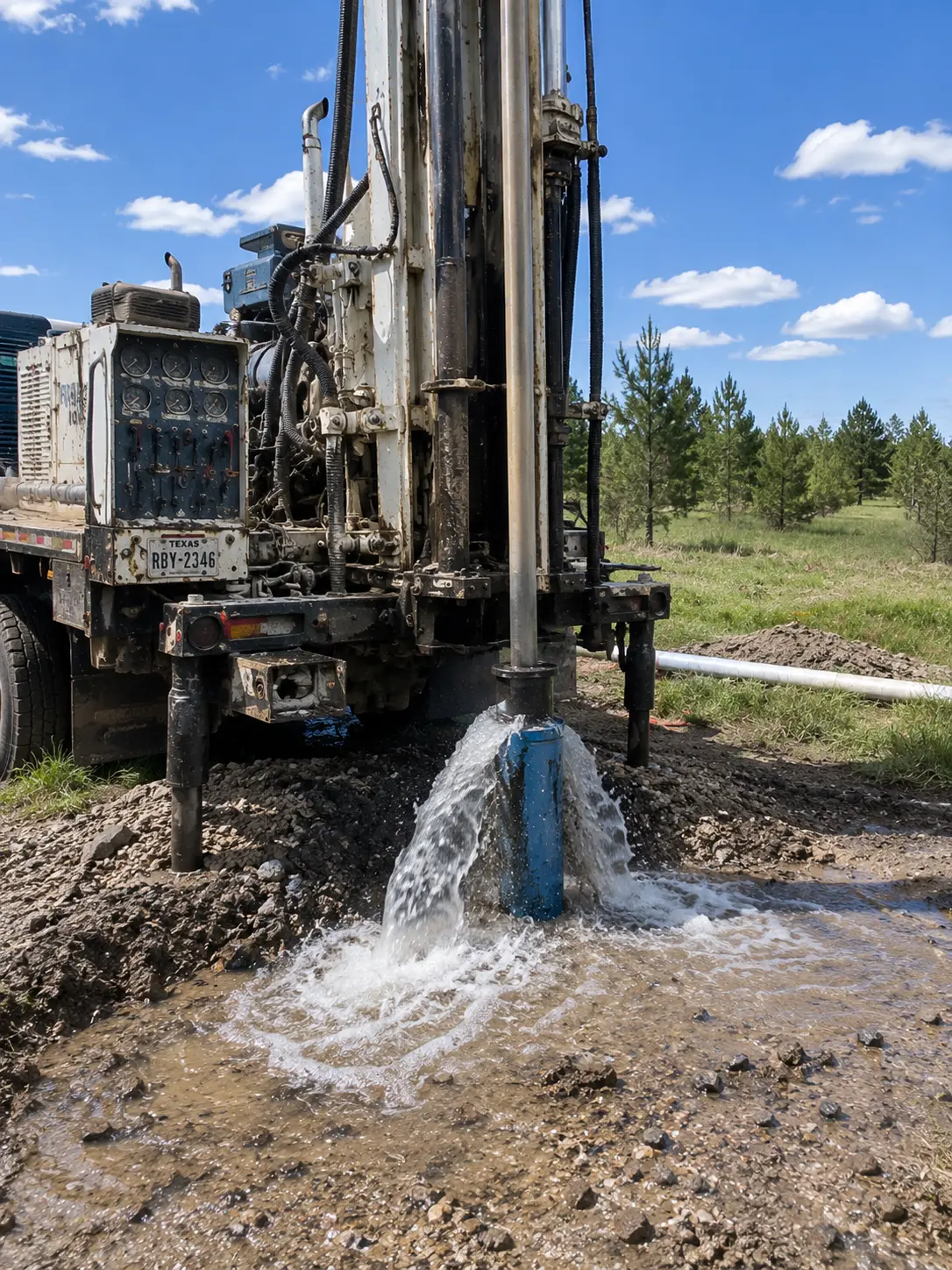
Evaluate the Site Before You Choose the Final Drilling Location
Drilling equipment can construct a borehole efficiently, but choosing where to place that borehole is a separate decision. A groundwater site assessment can help compare possible drilling locations before a contractor mobilizes equipment and begins construction.
How WaterFind USA Supports Your Water-Well Project
WaterFind USA helps property owners evaluate potential groundwater conditions before drilling. The groundwater survey is intended to provide additional information for the planning process. It does not replace the contractor responsible for designing and constructing the completed water well.
WaterFind USA can assist with:
- Groundwater site assessment
- Pre-drilling groundwater surveys
- Review of available water-well information
- Comparison of potential drilling locations
- Estimated water-bearing zone evaluation
- Seasonal project scheduling
- Water-well planning information
WaterFind USA Service Area
Winter Service Routes
- California
- Colorado
- Kansas
- Nevada
- Utah
Summer Service Routes
- Washington
- Idaho
- Montana
- Colorado
- Wyoming
Related Water-Well Planning Resources
Continue planning your water-well project with these resources:
- Learn how WaterFind evaluates groundwater before drilling.
- Review typical factors that affect water-well drilling costs.
- Compare direct rotary drilling methods.
- Learn how cable tool drilling works.
- Review groundwater survey pricing and seasonal service areas.
- Check available state water-well records before selecting a drilling location.
Frequently Asked Questions
What is direct rotary drilling?
Direct rotary drilling is a method that uses a rotating drill bit and continuously circulating drilling fluid to construct a borehole. The fluid travels down through the drill pipe and returns through the space between the pipe and borehole wall while carrying drill cuttings to the surface.
Is direct rotary drilling faster than cable tool drilling?
In many situations, yes. Direct rotary drilling generally provides higher penetration rates because drilling and cuttings removal occur continuously.
What is the purpose of drilling fluid in direct rotary drilling
Drilling fluid can remove cuttings, cool and clean the drill bit, help stabilize the borehole, suspend cuttings when circulation stops, and support efficient drilling. The exact drilling-fluid program depends on the formation and well design.
What types of drill bits are used for direct rotary drilling?
Common bit categories include drag bits, roller cone bits, and tricone bits. Drag bits are generally more suitable for softer formations, while roller cone and tricone designs can be used in harder formations.
Can direct rotary drilling be used in hard rock?
Yes, depending on the drilling equipment and bit selected. However, air rotary or DTH hammer drilling may sometimes provide faster penetration in very hard competent rock.
Can direct rotary drilling be used in sand and clay?
Yes. Direct rotary drilling can work effectively in many unconsolidated formations such as sand, silt, and clay. Drilling fluid can help support the borehole during construction.
What is the difference between direct rotary and air rotary drilling?
Direct rotary drilling usually uses drilling fluid to remove cuttings. Air rotary drilling uses compressed air. The better method depends on formation type, borehole stability, groundwater inflow, well depth, equipment availability, and contractor experience.
Can drilling fluid damage a water-bearing formation?
Improper drilling-fluid selection or management can contribute to formation plugging. Proper well development is important after drilling to remove residual drilling material and restore hydraulic connection with the aquifer.
Does direct rotary drilling guarantee water?
No. Direct rotary drilling is a borehole-construction method. It does not guarantee that a particular location will produce sufficient groundwater.
Should I have a groundwater survey before drilling?
A groundwater survey can provide additional information when comparing possible drilling locations. It can help identify promising areas for further investigation, but actual conditions still have to be confirmed through drilling and testing.
FIND US NOW!
We are based in Peris Valley, California. Email us today to discuss your project, request a customized estimate, and received a DocuSign Service Agreement to get started.
Toll-Free: +1 (877) 388-7388
Canadian Cell : +1 (403) 845-6676
Email: waterfind333@gmail.com