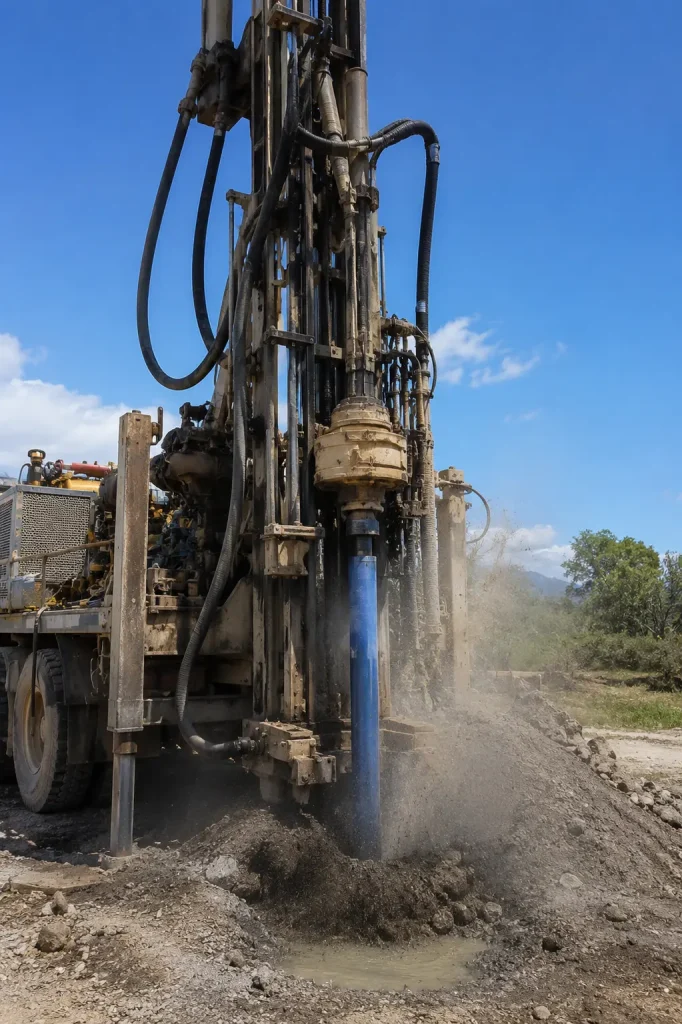
Cable Tool Drilling for Water Wells
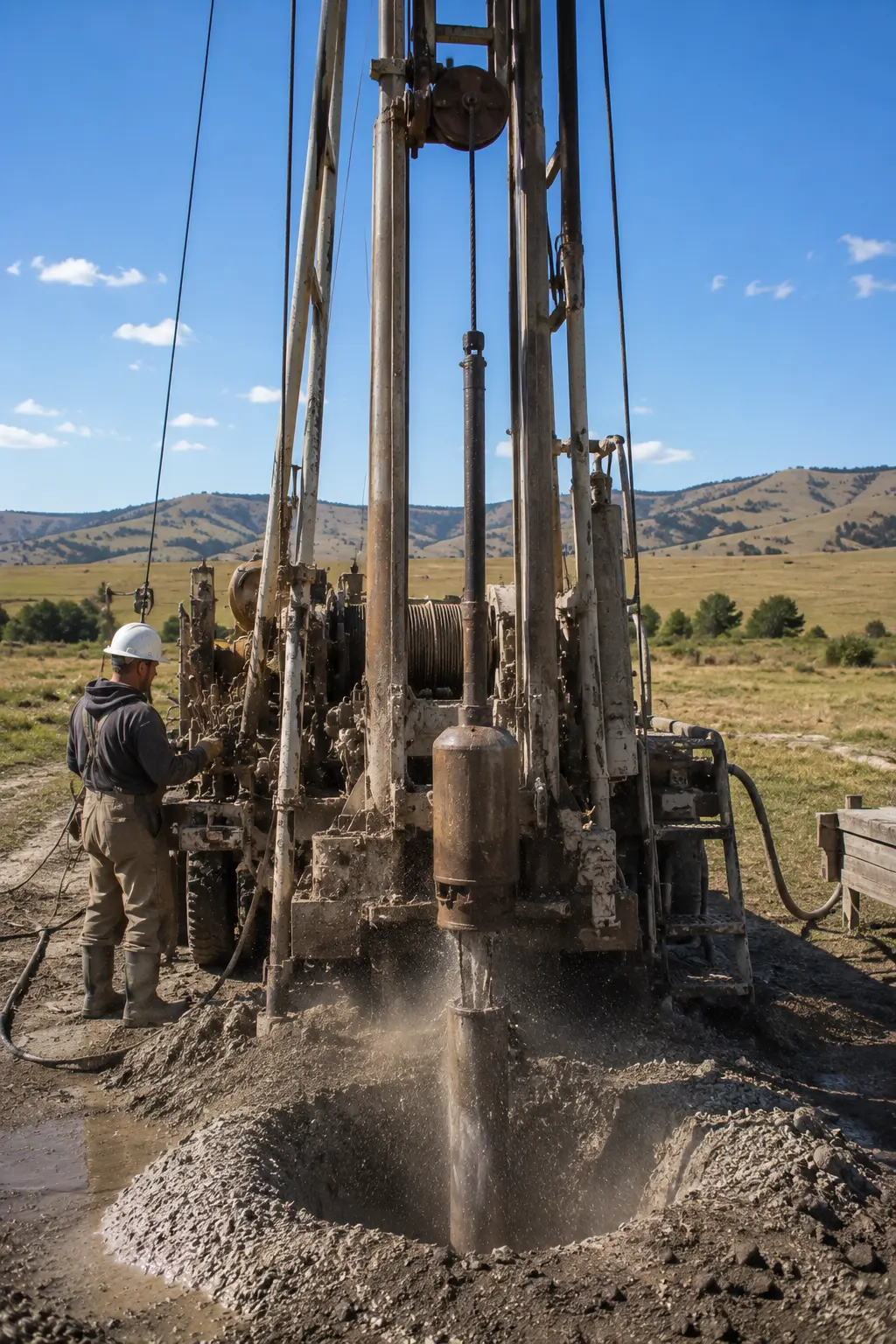
Cable tool drilling is a traditional percussion drilling method that can be used in a wide range of geological conditions. The method repeatedly raises and drops a heavy drill string into the borehole to break or loosen rock, gravel, sand, and other subsurface materials.
It remains useful in water-well construction where difficult formations, unstable ground, boulders, fractured rock, or lost circulation can make some rotary drilling methods challenging. Understanding how cable tool drilling works can help property owners better discuss drilling options with their contractor.
Before choosing the final drilling location, a groundwater site assessment can also help identify promising areas for further investigation.
What Is Cable Tool Drilling?
Cable tool drilling is a percussion-based method used to construct water wells.
It is also commonly known as:
- Percussion drilling
- Spudder drilling
- Cable tool well drilling
Unlike rotary drilling, which continuously rotates a drill bit, cable tool drilling repeatedly lifts and drops a heavy drill string into the borehole.
Each impact breaks, crushes, or loosens the subsurface material.
Water is often added to the borehole to mix with the loosened material and create a slurry. The slurry is then removed using a bailer or sand pump.
This process is repeated until the desired depth or water-bearing formation is reached.
Cable tool drilling can be used in:
- Hard rock
- Fractured rock
- Sand
- Gravel
- Cobbles
- Boulder formations
- Mixed geological conditions
- Unstable formations
The suitability of the method depends on the expected geology, well depth, casing requirements, equipment available, site access, and the professional judgment of the drilling contractor.
Important: Cable tool drilling constructs the borehole. It does not independently locate groundwater or guarantee a specific well yield.
How Cable Tool Drilling Works
Cable tool drilling relies on repeated percussion rather than continuous rotary cutting.
A heavy drilling assembly is suspended from a cable and repeatedly raised and dropped inside the borehole.
Each impact breaks or loosens material at the bottom of the hole.
A typical drilling process may include the following steps:
- The drilling rig is positioned over the proposed well location.
- The drill string is lowered into the borehole.
- The rig repeatedly lifts and drops the drilling tools.
- The drill bit breaks or loosens the formation.
- Water may be added to help create a slurry.
- The drill string is periodically removed.
- A bailer or sand pump removes the loosened material.
- Casing may be advanced as drilling progresses.
- The drilling process continues until the required depth is reached.
- The completed well is developed and tested.
The Cable Tool Drill String
A traditional cable tool drill string usually includes several main components.
These include:
- Drill bit
- Drill stem
- Drilling jars
- Swivel socket
- Drill line
Each component has an important role in the drilling process.
The Cable Tool Drill String
The drill bit is located at the bottom of the drill string.
It repeatedly strikes the subsurface formation and breaks or loosens the material.
Different bit designs may be used depending on the formation, including:
- Hard rock
- Soft rock
- Gravel
- Clay
- Sand
- Mixed formations
The condition and design of the drill bit can significantly affect drilling efficiency.
Drill System
The drill stem adds weight to the drill string.
The additional weight increases the force of each impact against the formation.
The appropriate drill-stem weight depends on the equipment, borehole diameter, formation type, and drilling conditions.
Drilling Jars
Drilling jars provide controlled movement within the drill string.
They can help the operator free drilling tools when they become stuck or tightly lodged in the borehole.
Jars are especially useful in difficult drilling conditions.
Swivel Socket
The swivel socket connects the drill line to the drill string.
It allows slight rotation during drilling and can help reduce cable twisting while promoting more even tool wear.
Drill Line
The drill line supports the drill string and transfers the lifting motion from the rig to the drilling tools.
Because the cable repeatedly carries substantial weight, it must be properly inspected and maintained.
Removing Cuttings With a Bailer
Unlike air rotary or mud rotary drilling, cable tool drilling does not continuously carry cuttings to the surface.
Instead, the drilling tools are periodically removed from the borehole.
A bailer or sand pump is then lowered into the hole.
The bailer collects the slurry made up of:
- Water
- Crushed rock
- Sand
- Gravel
- Clay
- Other loosened material
The bailer is then raised to the surface and emptied.
This process may be repeated several times before drilling continues.
Removing the cuttings helps keep the bottom of the borehole clean and allows the drill bit to continue working efficiently.
Unlike air rotary or mud rotary drilling, cable tool drilling does not continuously carry cuttings to the surface.
Instead, the drilling tools are periodically removed from the borehole.
A bailer or sand pump is then lowered into the hole.
Cable Tool Drilling in Consolidated Rock
Cable tool drilling can be used in consolidated formations such as:
- Limestone
- Sandstone
- Shale
- Granite
- Basalt
- Other competent rock formations
In hard rock, the drill bit repeatedly strikes the bottom of the borehole.
The repeated impacts crush and break the rock into smaller fragments.
Water may be added to create a slurry so the cuttings can be removed with a bailer.
Several factors can affect drilling speed, including:
- Rock hardness
- Rock fractures
- Drill bit condition
- Drill-string weight
- Stroke length
- Impact frequency
- Borehole diameter
- Amount of cuttings remaining at the bottom of the hole
Cable tool drilling in solid rock is usually slower than many modern rotary drilling methods.
However, the method can allow the operator to closely observe formation changes and groundwater entering the borehole.
Cable Tool Drilling in Sand, Gravel and Unconsolidated Formations
Cable tool drilling can also be used in loose or unconsolidated formations.
Examples include:
- Sand
- Gravel
- Cobbles
- Glacial deposits
- Loose sediments
- Boulder formations
In these conditions, the borehole may collapse if it is left unsupported.
For this reason, casing is often advanced as drilling progresses.
The casing helps:
- Support the borehole
- Prevent loose material from collapsing inward
- Protect completed sections of the borehole
- Isolate unstable formations
- Allow drilling to continue safely
The drill bit generally works slightly ahead of the casing.
As material is removed, the casing is gradually advanced deeper into the ground.
In difficult formations, smaller casing may sometimes need to be installed inside larger casing. This is commonly referred to as telescoping casing.
The drilling contractor should determine the appropriate casing procedure based on the actual geological conditions encountered.
When Is Cable Tool Drilling a Good Choice?
Cable tool drilling may be considered in certain geological and site conditions.
It may be useful when:
- The formation contains gravel, cobbles, or boulders.
- Loose material makes borehole stability difficult.
- Lost circulation creates problems for rotary drilling.
- Thin water-bearing zones need to be observed carefully.
- Large amounts of drilling fluid are undesirable.
- Casing must follow closely behind the drill bit.
- The geology contains fractured or broken rock.
- The formation contains cavities or highly disturbed zones.
- Access is limited for larger drilling equipment.
- The contractor has suitable cable tool equipment and experience.
Cable tool drilling is not automatically the best option for every water-well project.
The final drilling method should be selected by a qualified or properly licensed drilling contractor after considering:
- Expected geology
- Required well depth
- Water demand
- Borehole diameter
- Casing requirements
- Equipment availability
- Site access
- Local regulations
Advantages of Cable Tool Drilling
Works Across Different Geological Conditions
Cable tool drilling can be used in many consolidated and unconsolidated formations. It can be especially useful where the subsurface contains changing layers of:
- Rock
- Sand
- Gravel
- Cobbles
- Mixed materials
Minimal Circulation-Fluid Requirements
Cable tool drilling typically requires less circulating fluid than mud rotary drilling. This can be useful where:
- Lost circulation is a concern
- Fluid disposal is difficult
- Large amounts of drilling mud are undesirable
Can Identify Thin Water-Bearing Zones
Cable tool drilling progresses relatively slowly.
This can allow the operator to closely observe smaller changes in formation conditions and groundwater entering the borehole.
However, final sustainable yield cannot be confirmed until the well has been properly developed and pump tested.
Helpful in Difficult or Unstable Ground
Cable tool drilling may perform well in formations containing:
- Coarse gravel
- Boulder deposits
- Glacial till
- Broken rock
- Fractured formations
- Cavernous formations
Casing can often be advanced closely behind the drilling process to support unstable ground.
Good Formation Sampling
Because cuttings are periodically removed using a bailer, the drilling crew can examine the material brought to the surface.
This can help identify changes in:
- Rock type
- Grain size
- Formation conditions
- Potential water-bearing intervals
Smaller Equipment Footprint
Some cable tool rigs are smaller than large rotary drilling rigs.
This may make them useful on certain properties where access is limited.
Site conditions should still be evaluated before drilling equipment is mobilized.
Limitations of Cable Tool Drilling
Slower Drilling Rates
One of the main disadvantages of cable tool drilling is speed. Penetration rates are generally slower than modern rotary drilling systems This can increase drilling time on deeper wells or in very hard formations.
Deep Casing Can Become Difficult to Pull
Long casing strings may become difficult to remove because of friction between the casing and surrounding formation. This should be considered during well design.
Casing Costs Can Be Higher
Cable tool drilling may require substantial casing in loose or unstable formations. Additional casing can increase material and installation costs.
Specialized Experience Is Becoming Less Common
Cable tool drilling is less common than rotary drilling in many regions. Experienced cable tool contractors may therefore be more difficult to locate.
Cable Tool Drilling vs. Rotary Drilling
Different drilling methods are suited to different geological conditions.
| Factor | Cable Tool Drilling | Air Rotary Drilling | Mud Rotary Drilling |
| Basic drilling action | Repeated percussion | Rotating bit with compressed air | Rotating bit with drilling fluid |
| Typical speed | Usually slower | Often faster in hard rock | Often efficient in loose formations |
| Cuttings removal | Bailer or sand pump | Compressed air | Circulating drilling fluid |
| Hard rock | Suitable | Very suitable | Suitable in some conditions |
| Loose formations | Can be effective with casing | May require casing | Often suitable |
| Borehole support | Casing often follows drilling | May require casing | Drilling mud helps support the borehole |
| Fluid requirements | Relatively low | Usually limited | Usually higher |
| Formation observation | Very good | Good | May be more difficult |
| Equipment footprint | Often smaller | Usually larger | Usually larger |
| Common use | Mixed or difficult formations | Competent hard rock | Loose or unstable formations |
No single drilling method is best for every water-well project. The drilling contractor should select the method based on the actual formation, site conditions, equipment, and project requirements.
Cable Tool Drilling vs. Air Rotary Drilling
Air rotary drilling uses compressed air to continuously carry cuttings out of the borehole.
Cable tool drilling removes cuttings periodically using a bailer.
Air rotary drilling can be significantly faster in competent hard rock.
Cable tool drilling may be useful where:
- Loose formations are present
- Large boulders are encountered
- Borehole stability is difficult
- Lost circulation is a concern
- Casing needs to follow closely behind drilling
Learn more about air rotary drilling for water wells.
Cable Tool Drilling vs. Mud Rotary Drilling
Mud rotary drilling circulates drilling fluid through the borehole.
The drilling fluid helps:
- Carry cuttings to the surface
- Support unstable formations
- Cool the drill bit
- Maintain borehole stability
Cable tool drilling generally requires less circulating fluid.
This may be useful where drilling-fluid management is difficult.
Mud rotary drilling is often faster in deep unconsolidated formations.
The most appropriate method depends on the actual geology and well design.
Why Evaluate Groundwater Before Drilling?
Cable tool drilling determines how the borehole is constructed. IIt does not determine where the most promising groundwater target is located. Groundwater conditions can vary considerably across a property.
Two wells located relatively close to each other may encounter different:
- Well depths
- Rock formations
- Water-bearing fractures
- Aquifer thicknesses
- Water yields
- Water quality
Before drilling, property owners may benefit from reviewing as much information as possible.
A pre-drilling evaluation may include:
- Reviewing nearby water-well records
- Studying available geological information
- Evaluating property access
- Comparing possible drilling locations
- Completing a groundwater survey
- Estimating possible water-bearing zones
- Discussing the results with the drilling contractor
WaterFind USA uses advanced seismic methods and available well information to help evaluate potential groundwater conditions before drilling. Survey findings are estimates. Actual groundwater conditions can only be confirmed through:
- Drilling
- Well development
- Pump testing
- Water-quality testing
Evaluate Your Property Before You Drill
Groundwater conditions can change considerably over short distances. A groundwater site assessment can help you compare potential drilling locations before a drilling contractor mobilizes equipment and begins construction. The goal is to help you make a more informed drilling decision before committing to a borehole.
WaterFind USA helps property owners evaluate potential groundwater conditions before drilling. The purpose of the survey is not to replace the drilling contractor. Instead, the survey provides additional information that can support the planning process.
WaterFind USA can assist with:
- Groundwater site assessment
- Pre-drilling groundwater surveys
- Review of available water-well records
- Potential drilling-location comparison
- Estimated water-bearing zone evaluation
- Seasonal project scheduling
- Water-well planning information
Survey information can be shared with the contractor responsible for constructing the well.
The contractor can then consider:
- Groundwater survey results
- Nearby well records
- Site geology
- Required well depth
- Access conditions
- Drilling equipment
- Casing requirements
- Local regulations
- Intended water use
The final drilling method and well design should always be determined by the qualified contractor responsible for constructing the well.
WaterFind USA Service Area
WaterFind USA currently schedules seasonal service routes in selected western and central U.S. states.
Winter Service Routes
- California
- Colorado
- Kansas
- Nevada
- Utah
Summer Service Routes
- Washington
- Idaho
- Montana
- Colorado
- Wyoming
Routes, dates, lead times, travel requirements, and project availability may change.
Related Water-Well Planning Resources
Continue planning your water-well project with these resources:
- Learn how WaterFind evaluates groundwater before drilling.
- Review typical factors that affect water-well drilling costs.
- Compare direct rotary drilling methods.
- Learn how cable tool drilling works.
- Review groundwater survey pricing and seasonal service areas.
- Check available state water-well records before selecting a drilling location.
Frequently Asked Questions
What is another name for cable tool drilling?
Cable tool drilling is also commonly called percussion drilling or spudder drilling. The method repeatedly raises and drops a heavy drilling tool into the borehole.
Why would a contractor choose cable tool drilling instead of air rotary drilling?
Cable tool drilling may be useful where the subsurface contains loose formations, gravel, cobbles, boulders, broken rock, unstable formations, or lost-circulation zones. Air rotary drilling is generally faster in competent hard rock. The contractor should select the method best suited to the actual site conditions.
Can cable tool drilling be used in rock?
Yes. Cable tool drilling can be used in consolidated rock formations. The drill bit repeatedly strikes the rock and breaks it into smaller pieces. The drilling rate depends on rock hardness, tool weight, bit condition, stroke length, borehole diameter, and other site conditions.
Can cable tool drilling be used in sand and gravel?
Yes. Cable tool drilling can be used in sand, gravel, cobbles, and unconsolidated formations. Casing is commonly advanced as drilling progresses to prevent the borehole from collapsing.
Is cable tool drilling faster than rotary drilling?
Usually not. Cable tool drilling is generally slower than modern rotary drilling methods because the process requires repeated drilling and bailing cycles. However, the slower process can allow the operator to closely observe formation changes.
Does cable tool drilling require drilling mud?
Not necessarily. Water may be added to create a slurry that can be removed using a bailer or sand pump. The amount and type of fluid required depend on the formation and drilling conditions.
Can cable tool drilling find groundwater?
Cable tool drilling can reveal groundwater entering the borehole during construction. However, the drilling method itself does not predict the best drilling location before drilling begins. A groundwater survey can help compare possible drilling locations before construction.
Does finding water during drilling guarantee a productive well?
No. Water entering the borehole does not automatically confirm sustainable well yield. The completed well must be properly developed and pump tested.
Should I have a groundwater survey before drilling?
A groundwater survey can help compare potential drilling locations before committing to a borehole. It can provide additional information about possible water-bearing zones. However, survey findings remain estimates until drilling and testing confirm the actual conditions.
How much does cable tool drilling cost?
Cable tool drilling costs vary depending on required well depth, borehole diameter, formation type, casing requirements, mobilization distance, site access, equipment availability, local regulations, well development, and pump testing. Request a project-specific quotation from the contractor who will perform the drilling.
FIND US NOW!
We are based in Peris Valley, California. Email us today to discuss your project, request a customized estimate, and received a DocuSign Service Agreement to get started.
Toll-Free: +1 (877) 388-7388
Canadian Cell : +1 (403) 845-6676
Email: waterfind333@gmail.com